Global buyers face a crowded market when comparing HDPE tarpaulin types. Similar-looking sheets can differ in weave density, coating, weight, and edge reinforcement. Those differences become clear when a cover sits through strong sun, repeated rain, or daily handling.
This guide explores common Hdpe Tarpaulin options, from lightweight covers to reinforced, heavy-duty sheets. It explains how fabric construction and coating choices affect flexibility, water resistance, durability, and practical use. A thicker sheet is not automatically the better choice. Details matter.
Buyers should match product specifications to the job: covering goods in transit, protecting materials outdoors, or creating temporary worksite shelters. Check dimensions, GSM, eyelet spacing, seam construction, and stated UV-resistance information. Ask suppliers for current specification sheets and, where available, test documentation. These steps help buyers compare products more consistently, though they cannot guarantee performance in every climate or application.
Real conditions can be less tidy than a product table suggests. Wind may strain corners, and a poorly secured edge can fail before the fabric does. Even careful comparisons leave room for uncertainty. Treat this overview as a starting point, then verify details with the manufacturer and consider local weather, handling, and storage needs. A well-matched tarpaulin is often more useful than the most impressive specification on paper.
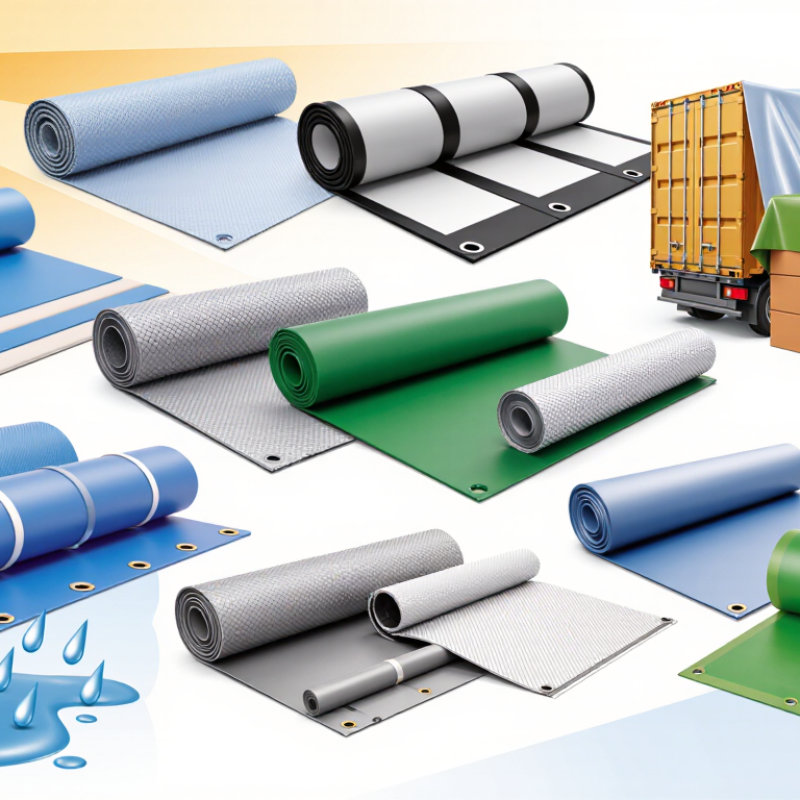
HDPE stands for high-density polyethylene. Its resin density commonly falls between 0.941 and 0.965 g/cm³. This value describes the polymer, not the finished tarpaulin. Density is measured under specified laboratory conditions, so compare figures only when suppliers use compatible test methods. Small differences matter, but they do not tell the whole story.
A tarp also contains woven tapes, coatings, and sometimes UV-protective additives. These components affect weight, flexibility, and outdoor life. Higher resin density may influence stiffness and strength, yet performance depends on formulation and manufacturing. Ask for the fabric’s mass per square metre, tensile test data, and coating details. Check sample edges, too. Uneven lamination can be visible there.
In practical sourcing, treat the density range as one specification, not a quality guarantee. A dense resin can still produce a poorly woven sheet. That distinction is easy to miss. For a covered load, examine tape spacing and seam construction; for repeated folding, test a sample in cool conditions. Results may vary by grade and process. It is worth asking how the reported density was measured, then comparing it with the actual tarp’s weight and intended use.
Across the 80–250 g/m² range, fabric weight helps narrow choices, but it does not guarantee service life. Around 80–110 g/m², tarpaulins are easier to handle and suit short-term dust or rain covers. Grades near 120–180 g/m² offer a practical middle ground for routine outdoor storage. At 200–250 g/m², the added mass can improve handling stability, though strong wind can still stress seams and eyelets.
These are buying-guide ranges, not universal grade definitions. Many tarpaulins use woven HDPE tapes with a polymer coating, so check the coating, weave density, seam construction, and UV-treatment details. PlasticsEurope’s Plastics – the Fast Facts 2024 reports 413.8 million tonnes of global plastics production in 2023. That figure shows the scale of plastics use; it does not establish tarp performance. I would not treat GSM as a durability score.
Tips: Ask for the stated mass tolerance and a technical data sheet. Compare samples in daylight; thin spots and uneven coating can be easy to miss. Specify the intended exposure and cover size. A heavier sheet may still disappoint if the tie-down points are weak. Also, supplier descriptions are not always comparable, which makes direct sample checks worthwhile.
Coated HDPE tarpaulins suit jobs where rain protection matters, such as covering building materials or outdoor equipment. A woven HDPE core gives the sheet strength, while its coating helps resist water and surface wear. Check the stated fabric weight, UV resistance, and reinforced edges before ordering. These details matter. A heavy sheet can still fail early if its seams are weak or it sits in harsh sunlight for long periods.
Laminated tarpaulins use a film bonded to woven fabric, often creating a smooth, light cover for short-term storage or transport. They can be easy to handle and wipe clean, but sharp corners may puncture them. Ask suppliers about thickness, tear strength, and how the edges are finished. A low price may reflect lighter construction, not a bargain for repeated use. Still, “coated” and “laminated” can overlap in product descriptions, so compare specifications rather than relying on labels alone.
Mesh tarpaulins are made for airflow and partial shade, not full rain protection. They work well over open loads, garden structures, or work areas where trapped heat and wind pressure are concerns. Air still moves. Compare mesh openness and edge reinforcement with the site conditions; a loose edge can flap and wear quickly. No type fits every job. Choose by exposure, handling frequency, and the material being covered.
| Tarpaulin Type | Typical Construction | Water Protection | Airflow and Light | Common Intended Uses | Buyer Considerations |
|---|---|---|---|---|---|
| Coated woven HDPE | Woven HDPE fabric with a polymer coating, commonly polyethylene-based, on one or both sides. | Typically water-resistant to waterproof when the coating and seams are intact. | Low airflow; generally blocks most direct light, depending on color and construction. | Outdoor equipment covers, temporary weather protection, agricultural covers, and general-purpose cargo covering. | Check coating coverage, seam construction, edge reinforcement, and UV-resistance specification for the intended exposure. |
| Laminated woven HDPE | Woven HDPE scrim with a thin polyethylene film laminated to one or both faces. | Usually provides a water-resistant or waterproof barrier while the laminate remains unbroken. | Low airflow; light transmission depends on the film color and opacity. | Temporary shelters, ground and material covers, packaging protection, and applications needing a continuous barrier. | Confirm laminate sides, puncture and tear requirements, and whether the product is suitable for repeated folding or abrasion. |
| HDPE shade mesh | Knitted or woven HDPE strands with open spaces between them; some versions include UV stabilizers. | Not waterproof; rain and air can pass through the openings. | High airflow; provides partial shade, with shade level varying by mesh construction and opening size. | Greenhouse and nursery shading, fencing screens, scaffolding debris netting, and windbreaks. | Choose by required shade level, mesh opening, airflow, edge finishing, and any applicable safety requirements. |
| Reinforced coated HDPE | Coated woven HDPE fabric with reinforced edges, extra-strength seams, or additional reinforcement in selected areas. | Typically water-resistant to waterproof when properly made and maintained. | Low airflow; usually intended to act as a cover rather than a breathable screen. | Frequent-use covers, larger outdoor covers, and applications where edge or attachment strength is important. | Review reinforcement placement, grommet spacing and material, seam strength, and the expected load and installation method. |
| Breathable woven HDPE cover | Woven HDPE construction designed to allow some air exchange; permeability varies by weave and any surface treatment. | Water protection varies; breathable versions may not provide a fully waterproof barrier. | More airflow than fully coated or laminated sheets; light transmission varies by fabric density. | Selected agricultural and storage covers where reducing trapped moisture is important. | Ask for measured water resistance and air-permeability data; “breathable” does not mean waterproof. |
Specifications vary by fabric weight, weave, coating or laminate, seam design, color, and UV-stabilizer formulation. Confirm product test data and local requirements before purchase.
For HDPE tarpaulins, reinforcement claims need measurable evidence, not just a heavier feel. ASTM D751 provides test methods for coated fabrics, including breaking strength, tear resistance, and coating adhesion. Test warp and weft directions separately, since woven reinforcement can perform differently across each axis. Record specimen conditioning, dimensions, and test settings. Small details matter. Compare results from the same method before choosing a tarp for repeated loading, folding, or wind exposure.
UV performance needs a separate check. ASTM D751 does not, by itself, establish outdoor UV lifetime. Pair mechanical testing with controlled UV exposure, such as ASTM G154, then retest strength and inspect for brittleness, fading, or coating cracks. The WHO/WMO Global Solar UV Index guide classifies UVI 8–10 as very high and recommends sun protection from UVI 3. This is useful exposure context, not a direct tarp-life prediction. Lab hours cannot be converted neatly into years outdoors; climate, shade, and installation tension all matter. A careful buyer should ask for both test conditions and post-exposure results.
2026 Top HDPE Tarpaulin Types for Global Buyers
GSM is a useful starting point, not a performance guarantee. ISO 2286-2 defines methods for measuring the mass per unit area of coated fabrics. A heavier HDPE tarpaulin may feel stiffer, but yarn construction, coating, and weave also affect service life. Check the actual GSM against the supplier’s test report. Then compare tear resistance in both warp and weft directions, using results tested to ISO 4674-1. A sheet can resist a snag in one direction and split more easily across the other. Small detail. Big difference.
For tensile strength, request results measured under ISO 1421, which covers tensile testing of coated fabrics. Compare like with like: test method, specimen width, direction, and conditioning should match. A bare figure is hard to interpret. For example, a reported value in N/5 cm should not be compared directly with one stated in N/cm. Ask for the original report, not only a sales-sheet claim. ISO standards define test procedures; they do not set one universal pass mark for every tarp application. That part is easy to overlook.
Match the results to the job. A cover pulled tightly over a load needs dependable tensile performance at its tie points; repeated handling makes tear data important too. Request batch-specific results and confirm that GSM, tear resistance, and tensile values describe the same construction. ISO 1421 and ISO 2286-2 provide recognized test methods, but a test number cannot predict every field failure. It is still worth checking the seams and eyelet zones. Those are often the weak spots.
For an immediate response, please call this
number 45038523
Price: