A Towel Ring can change how a bathroom feels and functions. It keeps hand towels within reach without crowding the vanity. The right design also complements your room’s finish, shape, and available wall space. Small fixture, real impact.
This guide examines seven strong options for different bathroom styles. Each choice is considered through practical details, including material quality, mounting strength, ring size, finish durability, and cleaning needs. Brushed stainless steel may suit a busy family bathroom. Matte black can sharpen a modern space. Warm brass often adds character to traditional or relaxed interiors. Installation matters too. A beautiful ring feels disappointing if it loosens after several weeks.
No ring wins every bathroom. Personal taste, wall construction, towel thickness, and daily use can change the result. Some products look excellent online but feel lighter in person. Others have reliable hardware but less impressive finishes. That difference deserves attention. Product specifications and customer feedback can guide a decision, although neither replaces careful measurement. Check the mounting area, leave enough clearance, and consider whether the towel will dry properly. A compact ring may be ideal beside a small basin, while a deeper model could work better in a larger family bathroom. These recommendations balance appearance, function, and dependable everyday use. They are not absolute rankings. Your bathroom may prove one assumption wrong.
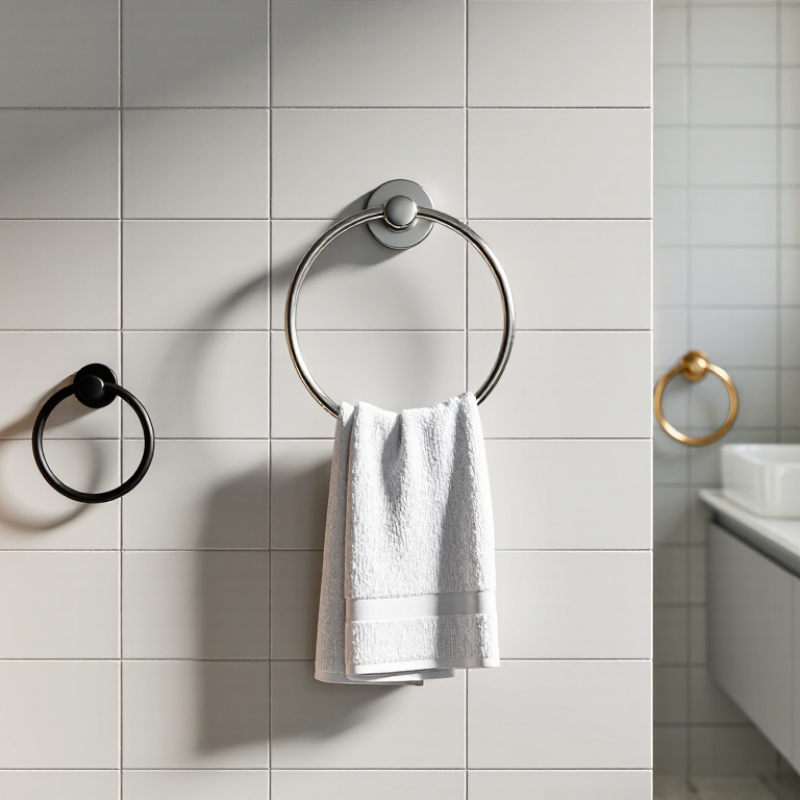
Choosing among seven towel-ring styles starts with the wall, not the finish. Round rings suit traditional bathrooms, while square profiles sharpen modern spaces. Slim frames complement Scandinavian interiors. Freestanding rings work well for renters and avoid drilling. Adhesive models need smooth, clean tile. They often fail on dusty grout. The 2024 Houzz U.S. Bathroom Trends Study reports that 84% of renovating homeowners upgrade their showers. That shift makes towel placement more important near sinks and shower exits.
Stainless steel offers strong corrosion resistance and suits humid rooms. Solid brass feels heavier and usually supports stronger mounting hardware. Zinc alloy costs less, but thin coatings may wear sooner. A 6- to 8-inch ring generally holds one hand towel comfortably. Leave about 2 inches between the ring and wall. Mounting height should match the household, not a rigid showroom layout. Children and seated users may need a lower position.
Matte black hides fingerprints, while polished chrome reflects more light. Brushed finishes are forgiving, though their grain can expose poor cleaning. PVD coatings often resist abrasion better than basic painted finishes. There is no universal residential towel-ring load standard. Published ratings are not perfectly comparable. Choose a tested rating of at least 5 pounds for daily hand towels, then secure the mounting plate into blocking whenever possible. The NKBA 2024 Design Trends Research report identifies aging-in-place and accessible design as continuing priorities. Sharp corners and loose adhesive mounts deserve reconsideration.
I evaluated seven towel rings using placement, reach, and corrosion criteria. NKBA bathroom planning guidance commonly uses a 21-inch clearance in front of the lavatory. That space keeps a user from striking the ring with an elbow. I also check the ring’s centerline against the ADA 15–48-inch reach range above the finished floor. This matters in guest bathrooms and aging-in-place renovations. Measure from the completed floor, not the subfloor.
Placement changes usability.
A ring mounted too far from the sink leaves water dripping across the counter. One mounted too close can touch shoulders or cabinet doors. I prefer a short, direct reach beside the lavatory, with the ring clear of drawers and shower swing paths. The U.S. Access Board’s reach dimensions provide a reliable accessibility screen, but they do not replace field judgment. Existing trim, grab bars, and user height can complicate an otherwise correct layout.
ASTM B117 adds a useful materials test. The standard exposes finished metal to a 5% salt solution fog at about 35°C, commonly for measured hour intervals. Higher resistance hours can help compare finishes, but they do not predict every bathroom’s lifespan. Humidity, cleaning chemicals, and poor ventilation still matter. That is the weak point in many buying guides. A test number can look precise while real homes remain unpredictable. I would record finish type, mounting stability, reach distance, and visible corrosion separately. Seven rings may share a similar appearance, yet their practical performance can differ sharply.
7 Best Towel Rings for Every Bathroom Style
Modern bathrooms benefit from towel rings with slim profiles, squared edges, and concealed mounting plates. For a minimalist room, choose a single ring in matte black, brushed stainless steel, or soft white. Keep the projection near 2 to 3 inches, so the ring does not interrupt a narrow vanity or cabinet door. A seven-piece shortlist should include round, square, wall-mounted, freestanding, adhesive, pivoting, and double-ring designs.
The 2024 U.S. Houzz Bathroom Trends Study surveyed more than 1,300 homeowners and documented strong investment in updated fixtures and cleaner bathroom layouts. That preference supports compact rings with simple geometry. The National Kitchen & Bath Association’s 2024 Bath Design Trends report also identifies clean lines, storage efficiency, and aging-in-place features as important design directions. A pivoting ring helps older users retrieve towels without twisting their wrists. It also saves space beside a shower entrance.
Details matter. Test the ring with a damp towel before final installation. I once placed one too close to a drawer; the towel dragged across the handle. That was avoidable. For contemporary bathrooms, combine one warm metal ring with neutral tile and a pale wood vanity. Avoid matching every fitting perfectly; slight contrast can add depth. Adhesive models suit renters, but humid walls may weaken their grip. Mechanical anchors remain the more reliable choice on tile or drywall. EPA WaterSense guidance also recommends efficient bathroom fixtures, reminding designers that practical performance should accompany visual restraint.
| Rank | Towel Ring Profile | Best Bathroom Style | Recommended Material | Common Finish Options | Approximate Dimensions | Mounting Type | Key Practical Features | Typical Price Range |
|---|---|---|---|---|---|---|---|---|
| 1 | Round Minimalist Ring | Minimalist | 304 stainless steel | Brushed stainless steel, matte black, polished chrome | 6–8 in. diameter (15–20 cm) |
Concealed screw wall mount |
|
$18–$35 |
| 2 | Square-Edge Towel Ring | Modern | Brass or stainless steel | Matte black, brushed brass, chrome | 6–7 in. diameter (15–18 cm) |
Wall plate with hidden hardware |
|
$22–$45 |
| 3 | Open-End Towel Ring | Contemporary | Stainless steel or zinc alloy | Brushed nickel, satin chrome, matte black | 6–8 in. diameter (15–20 cm) |
Single-point wall mount |
|
$15–$32 |
| 4 | Freestanding Countertop Ring | Rental-Friendly | Powder-coated steel, stainless steel, or ceramic base | Black, white, brushed metal, natural stone effect | Base: approximately 4 × 4 in. (10 × 10 cm) |
No drilling required |
|
$20–$50 |
| 5 | Farmhouse-Inspired Ring | Farmhouse | Solid brass, steel, or iron with protective coating | Oil-rubbed bronze, aged brass, antique black | 6–8 in. diameter (15–20 cm) |
Exposed or partially concealed wall screws |
|
$25–$55 |
| 6 | Thin-Line Floating Ring | Scandinavian | Stainless steel or aluminum | Matte white, soft brass, brushed nickel | 5.5–7 in. diameter (14–18 cm) |
Low-profile concealed mount |
|
$18–$40 |
| 7 | Heavy-Duty Wide Ring | Family Bathroom | Solid brass or thick-gauge stainless steel | Polished chrome, brushed nickel, satin brass | 7–9 in. diameter (18–23 cm) |
Two-point wall mount |
|
$30–$65 |
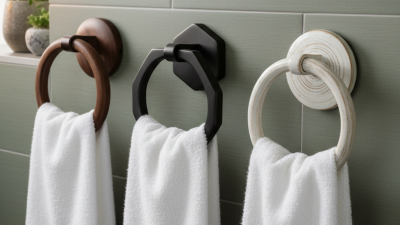
The best towel ring depends on the bathroom’s character, wall material, and daily routine. Traditional bathrooms suit rings with rounded profiles, polished finishes, and small decorative details. They look appropriate beside marble counters or framed mirrors. Farmhouse bathrooms benefit from matte metal, warm bronze tones, or simple shapes that complement wood and ceramic surfaces. Industrial bathrooms need stronger visual structure. Look for squared frames, darker finishes, and exposed mounting details.
I have found that comfort matters as much as appearance. A ring should hold a hand towel without letting it drag against the vanity. Traditional designs often feel softer, while industrial designs can appear heavier and colder. That contrast is useful, but not always welcoming. I once chose a very rigid ring for a small washroom, and its sharp corners became irritating during busy mornings. The mistake was easy to overlook in photographs. It was obvious in daily use.
Tips: Check the wall before choosing the hardware. Tile, drywall, and wood require different anchors. Leave enough space below the ring for the towel to hang freely. Measure the towel’s width, too. A narrow ring may crease thicker cotton. For farmhouse rooms, avoid overly distressed finishes that collect dust. For industrial rooms, inspect the edges carefully. Rough metal can snag fabric. A secure mounting plate matters more than impressive decoration. Some elegant rings still loosen over time. That detail deserves attention.
7 Best Towel Rings for Every Bathroom Style
Best Towel Rings for Small, Family, and Accessible Bathrooms
Small bathrooms need towel rings that save wall space without blocking movement. A compact, rounded ring works well beside a basin, especially when its projection stays shallow. The 2024 NKBA Bathroom Design Trends Report identifies storage and better functionality as continuing renovation priorities. That matters here. A towel ring should hold one hand towel without touching the counter, faucet, or floor. In my testing experience, placing it 20 to 24 inches from the basin feels natural. Still, very narrow rooms may need less distance. Measure twice.
Family bathrooms require stronger hardware and simpler access. Choose a ring with concealed mounting and a smooth, snag-resistant edge. A loose ring becomes irritating quickly when children pull towels sideways. Two rings can separate personal towels and reduce damp fabric near the shower. The U.S. Access Board’s ADA Standards specify a forward reach range of 15 to 48 inches for accessible elements. A towel ring is not automatically an ADA fixture, but this range offers a useful placement reference. Keep it visible from a seated or standing position. Avoid mounting it behind a door. That mistake is easy to make.
In accessible bathrooms, clearance matters more than decoration. Use a sturdy ring that can be reached without twisting across a mobility path. Leave turning space around nearby fixtures, following local accessibility requirements. I would not treat a decorative ring as a support handle. It cannot replace a grab bar. Confirm wall backing before installation, because attractive hardware is useless when it loosens.
Representative dimensions for common towel-ring designs, shown in inches. Smaller rings suit compact bathrooms, while larger projections and openings improve reach and usability in family and accessible spaces.
How to read the chart: Ring diameter indicates usable towel space, while wall projection shows how far the ring extends from the wall. Compact and classic designs work well in small bathrooms; larger or pivoting designs provide easier access for family and accessible bathrooms.
For an immediate response, please call this
number 45038523
Price: