The question, “Who Makes the Best Undermount Kitchen Sink in China?” has no simple answer. A polished product photo cannot reveal how a basin performs after years of daily use. Buyers should compare manufacturers by construction, quality controls, customization, and after-sales support—not price alone.
Start with practical details. Check the stainless steel grade and thickness, corner radius, weld consistency, and surface finish. Look closely at drain placement, overflow design, and the underside sound-dampening pads. These features affect installation, noise, cleaning, and everyday comfort. Ask for current specifications and inspection records, then compare them with a physical sample when possible. Details matter.
A dependable supplier should explain production capabilities clearly and provide consistent answers about tolerances, packaging, and replacement parts. Factory visits or third-party inspections can help verify claims, but neither replaces careful review of an actual sink. Warranty terms also deserve attention; vague promises are not reassuring. One awkward seam or uneven finish may tell you more than a glossy catalogue. That may sound picky, but kitchens are used hard.
This guide examines what distinguishes strong Chinese manufacturers and how buyers can evaluate them fairly. It considers product quality, factory experience, communication, and value for different projects. No ranking can suit every home or budget. The best choice is the supplier whose evidence, product, and service match your requirements—and whose claims hold up when checked.
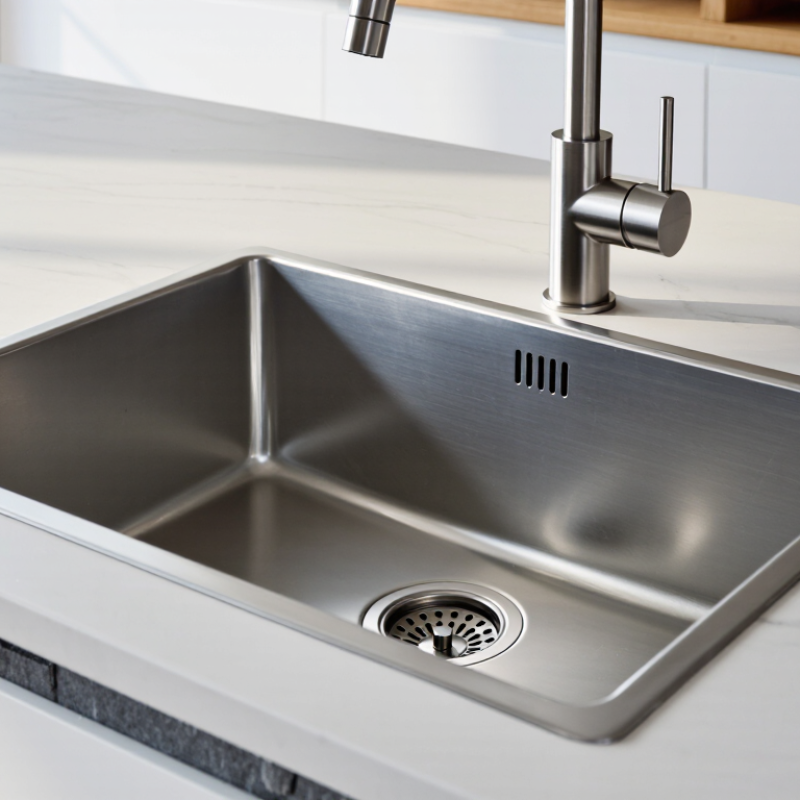
An undermount kitchen sink is installed beneath the countertop, rather than resting on its surface. The counter’s cut edge remains visible around the basin. This creates a smooth transition from worktop to sink, so crumbs and water can be swept directly into the bowl. A practical detail. There is no raised rim to catch them.
The installation depends on more than the sink itself. The countertop opening must match the basin, and the cabinet needs suitable support for the sink’s weight, especially when it is full. Installers typically secure the basin beneath the counter and seal the joint to help limit water intrusion. The exact method depends on the counter material and sink design. A clean-looking seam is useful, but it still needs regular inspection; sealant can age, and small leaks may go unnoticed inside a cabinet. Undermount sinks are commonly paired with solid-surface or stone counters, while compatibility should be checked before purchase. It is an elegant setup, but not a maintenance-free one.
Choosing who makes the best undermount kitchen sink in China requires more than comparing product photos. Evaluate the manufacturer’s process, records, and willingness to explain details. Ask for the steel grade and thickness, then check whether those specifications match the sample and order documents. A smooth finish is useful, but it cannot prove consistent material quality. Ask for proof.
Inspect the sink’s underside and corners. Look for even welds, clean grinding, secure sound-dampening pads, and a drain opening that sits level. Request a sample and measure its bowl depth, rim flatness, and drain position. Then ask how the factory checks these points across a production run. A careful supplier should describe its inspection steps and share relevant quality records without vague promises.
Packaging matters too. Ask how the sink is protected from scratches and impact during shipment, and review photos of packed goods. Clarify how defects are recorded and handled before placing an order. A factory visit can reveal useful details, though one visit cannot represent every shift or batch. No checklist is perfect. Recheck key specifications against the final production sample, especially when custom dimensions are involved.
Chinese undermount sink makers generally fall into three groups: specialist sink factories, OEM/ODM manufacturers, and broader kitchen-equipment producers. Specialist factories focus on bowl geometry, steel forming, drainage, and mounting. OEM/ODM plants can adapt dimensions and finishes to buyer specifications. Larger kitchen-equipment producers may offer sinks alongside cabinets and taps, but their sink expertise varies.
Grand View Research estimated the global kitchen sinks market at about US$3.4 billion in 2023 and forecast growth of roughly 4.2% annually from 2024 to 2030. This market estimate signals steady demand, not proof that any factory is superior. Buyers should compare material certificates, steel thickness, weld quality, and sample consistency. Look closely at the underside: clean seams and reinforced clips matter once a heavy, water-filled bowl is installed.
Factory labels can be fuzzy. Not always. Ask each supplier for a drawing, a finished sample, and documented inspection criteria. A useful test is checking whether the drain aligns with the cabinet cutout without forcing the installer to improvise. I would also verify packing protection; a polished rim can still arrive scratched after a long shipment. One overlooked weakness: a good sample does not guarantee every production batch matches it.
Leading Chinese sink makers include stainless-steel specialists, who commonly work with grades such as 201, 304, and 316. This chart compares the midpoint chromium and nickel content specified for these grades—not manufacturers or brands.
How to read it: Values are percentage midpoints calculated from the composition ranges in ASTM A240/A240M: 201 (Cr 16–18%, Ni 3.5–5.5%), 304 (Cr 18–20%, Ni 8–10.5%), and 316 (Cr 16–18%, Ni 10–14%). Actual material should be confirmed through mill certificates and product documentation. The most suitable maker depends on your material, fabrication, and installation requirements.
An undermount sink depends on more than its appearance. Material choice affects noise, maintenance, and resistance to everyday wear. Stainless steel is widely used; buyers should request its grade and thickness, not rely on “heavy-duty” wording alone. A sample tells part of the story. It cannot prove every production batch will match.
Design details matter at installation. Check bowl depth, corner radius, drain position, and the width of the rim that sits beneath the counter. A tight corner can look crisp but may take more effort to clean. Drainage should be tested with water, not judged from a drawing. Small flat spots can leave puddles. They happen.
Production quality varies with tooling, welding, polishing, and inspection routines. Ask how the factory checks rim flatness, surface finish, and dimensional tolerance. For a large order, compare a production sample with the approved drawing and inspect several units, not just one.
Sound-dampening pads and undercoating can reduce noise, though placement and coverage differ. Also clarify packaging: exposed edges can be damaged during handling. Specifications help, but they are not a substitute for checking the actual sink.
Choosing a Chinese undermount sink manufacturer takes more than comparing catalogue photos. Check the steel grade, measured thickness, bowl dimensions, and edge finish. Ask for material certificates and independent test reports, then confirm they match the production model. A 2023 report from the International Stainless Steel Forum recorded 36.7 million tonnes of stainless steel production in China, out of 58.4 million tonnes worldwide. That scale signals a strong supply base, not guaranteed sink quality.
Tips: Ask for a physical sample. Check the underside, drain opening, and mounting rim. A neat showroom finish can hide uneven polishing or thin sound-dampening pads. Ask how the factory checks welds and dimensional tolerances. Get the answers in writing.
Before ordering, request a live video walkthrough of the production line and a recent inspection record. Compare the approved sample with the final inspection checklist, including dimensions and surface defects. Confirm packaging protects the rim; a small dent can complicate installation beneath a stone countertop. Check references for similar sink models, not just general export experience. Price matters, but very low quotes deserve closer scrutiny. One weakness in this process: paperwork can look convincing, so verify reports with the issuing laboratory where possible.
For an immediate response, please call this
number 45038523
Price: