China Top 10 Glass Condiment Bottle Manufacturers
China’s glass industry serves food brands seeking dependable packaging, from small chilli-oil jars to clear vinegar bottles with narrow-neck pourers. This guide to China Top 10 Glass Condiment Bottle Manufacturers helps buyers compare suppliers beyond catalogue photos. A Glass Condiment Bottle must suit its contents, filling process, closure, and shelf presentation. Small details matter: neck-finish consistency, cap fit, glass thickness, and carton protection can affect production and delivery.
Industry data provides useful context, though it cannot rank individual factories. FEVE’s 2022 reporting places Europe’s glass packaging recycling rate at about 80%, reflecting glass’s established role in reusable and recyclable packaging systems. That figure describes Europe, not China or any specific manufacturer. It does, however, underline why buyers increasingly ask suppliers about recycled content, lightweight designs, and clear material specifications. Confirm claims directly with each factory.
This overview considers product range, customization, quality controls, production capacity, export experience, and communication. Buyers should request samples and verify dimensions, closure compatibility, and food-contact documentation before placing large orders. A polished website is not proof of consistent output. Nor is the lowest quotation always the best value; fragile pallets or uneven finishes can erase apparent savings. A ranking can look precise. Supplier fit is not. Factory capabilities change, and public information may be incomplete. Use the list as a starting point, then compare evidence against your own product requirements.
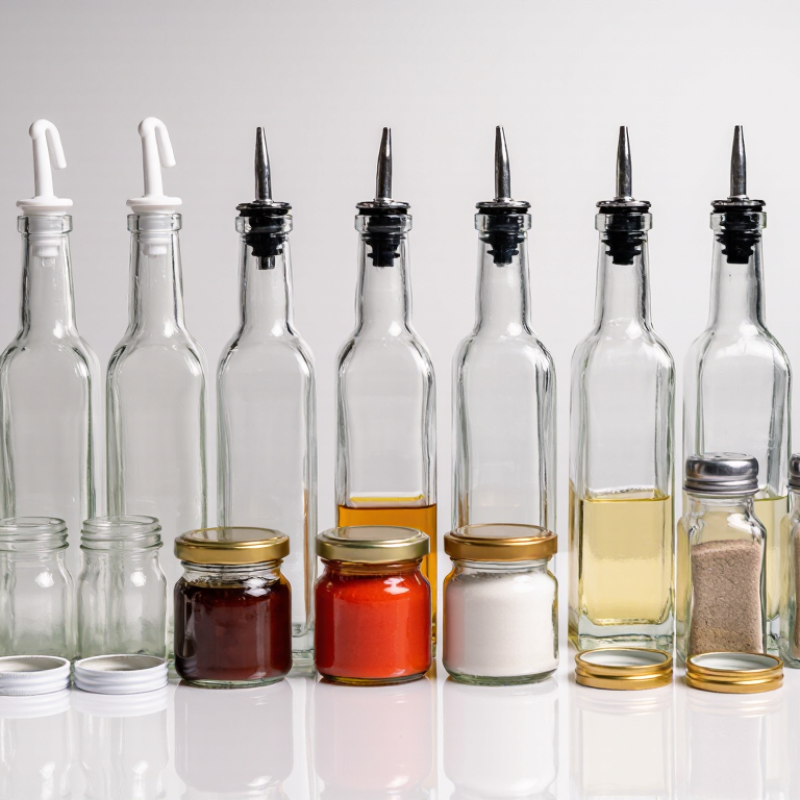
Overview of China’s Glass Condiment Bottle Manufacturing Industry
China’s glass condiment bottle industry sits within a much larger food-packaging supply chain. Bottles must handle acidic sauces, salty liquids, and frequent opening without leaking. Buyers usually assess glass clarity, neck finish, wall thickness, and cap fit—not appearance alone. Small defects matter. A slightly uneven rim can cause sealing problems on a filling line.
Fortune Business Insights estimated the global glass packaging market at US$55.91 billion in 2023, with a projected 4.5% compound annual growth rate through 2032. This is a global figure, not a measure of China’s condiment-bottle output. Still, it signals sustained demand for glass packaging across food and beverage markets. China’s manufacturing base benefits from established glass-forming and decoration capabilities, while production costs and delivery times vary by province, order volume, and bottle design.
For procurement teams, sample testing is more useful than relying on a catalogue image. Check bottle weight, capacity tolerance, neck dimensions, and resistance to thermal shock. Ask how the factory monitors defects and maintains batch consistency. Important details. One limitation deserves attention: broad market reports rarely separate condiment bottles from other glass containers. So their growth figures should not be treated as direct evidence of demand for a particular bottle shape.
How Glass Condiment Bottles Are Designed and Produced
Designing a glass condiment bottle starts with its contents and the way people pour them. A narrow neck can help control thin vinegar, while a wider opening suits thicker sauces. The bottle should also stand steadily on a damp kitchen counter. Designers consider capacity, hand feel, label space, and the fit of the closure before shaping a prototype. Small details matter. A shoulder that looks elegant on screen may make the bottle awkward to grip.
Production turns the approved design into a repeatable shape. Glass ingredients are melted in a furnace, then measured portions are formed in molds. The hot bottles pass through an annealing lehr, where controlled cooling helps reduce internal stress. Mold condition, temperature, and forming speed can affect wall thickness and appearance. Manufacturers check samples for dimensions, capacity, surface defects, and closure fit. Even a slight variation can change how a cap seals.
After forming, bottles may receive coatings, printing, or labels, depending on the design. Inspection should include practical handling, not only visual checks: a filled sample can reveal pouring drips or an unstable base. Then comes inspection. Packaging also matters, since glass can chip when bottles knock together during transport. Not every design choice works perfectly on the first run; feedback from production and everyday use can lead to useful adjustments.
Criteria for Identifying Leading Chinese Manufacturers
Choosing a leading glass condiment bottle manufacturer requires more than comparing catalog photos or quoted prices. Check whether the factory can hold consistent bottle weight, wall thickness, capacity, and neck dimensions across repeat orders. Ask for sample bottles from a regular production run, not only a hand-selected display piece. Small variations can affect filling lines and cap fit. Details matter.
Review the manufacturer’s quality controls, including inspection frequency, defect records, batch traceability, and procedures for handling breakage. For food packaging, request relevant material and testing documents, then confirm they match the bottle and intended use. A site visit or independent audit can reveal how glass is formed, annealed, and packed. Still, one visit is only a snapshot. Lead times, minimum order quantities, export experience, and communication during design changes also deserve careful checks. I would not rank a supplier on price alone; however, documentation can look convincing while actual consistency remains uneven. A pilot order helps test performance under real filling and transport conditions before larger commitments.
Profiles of Ten Chinese Glass Condiment Bottle Manufacturers
Profiles of ten Chinese glass condiment bottle manufacturers are most useful when they compare factory capabilities, not just catalogue photos. Look for clear details on bottle capacity, neck finish, glass weight, mold options, and monthly output. A 250-millilitre sauce bottle and a slim vinegar bottle may need different filling and labeling lines. Check whether each producer offers food-contact documentation and sample testing. Small details matter.
The profiles can distinguish specialists in oil bottles, sauce containers, seasoning jars, custom molds, and export packaging. They should also explain how manufacturers handle color consistency, rim quality, carton protection, and order-size flexibility. Grand View Research estimated the global glass packaging market at USD 68.5 billion in 2023, with projected annual growth of 4.4% from 2024 to 2030. That wider market context makes production reliability worth comparing.
Sustainability deserves practical scrutiny. FEVE reported an 80.1% glass-container recycling rate in Europe for 2022, although collection systems vary by market. Ask suppliers for bottle-weight data and recycled-content information, rather than relying on broad environmental claims. There is no perfect supplier. Published capacity figures can be hard to compare, and sample quality may not fully represent mass production. A careful profile should state those limits.
Typical Soda-Lime Glass Composition for Packaging
Representative composition by weight; actual formulations vary by manufacturer and product requirements.
Silica is the main glass-forming ingredient. Soda helps lower the melting temperature, while lime and other oxides contribute to the glass’s stability and performance.


