How to Choose the Best Round Trampoline in 2026
Choosing the best Round Trampoline in 2026 takes more than comparing prices or counting springs. The market is growing: Grand View Research estimated the global trampoline market at about US$3.2 billion in 2023, with projected growth through 2030. That figure signals broad demand, not better safety or quality. A popular model can still be the wrong fit for your yard.
Safety deserves more weight than glossy product photos. The U.S. Consumer Product Safety Commission’s NEISS system tracks emergency-department injuries, including trampoline-related cases. ASTM International’s consumer trampoline safety specification also sets guidance for design, assembly, and use. These sources offer useful context, but neither certifies every product sold online. Check the exact model’s documentation, enclosure design, frame construction, weight limit, and replacement-part availability. Then measure the usable yard space, including room around the frame. A tape measure on the grass is less exciting than a big bounce. It is also more useful.
A practical comparison should consider who will use the trampoline, how often, and who can supervise. Look closely at the mat, padding, net attachment points, and weather-resistant finishes. Ask whether the seller provides clear assembly instructions and a traceable warranty. Price matters, but so does the cost of maintaining the product over time. A small admission: no checklist can predict every real-world setup or user habit. The best choice is the one that fits your space and routine, with safety features you can inspect and maintain—not simply the largest or cheapest option.
Define Round Trampolines and the ASTM F381 Consumer Safety Standard
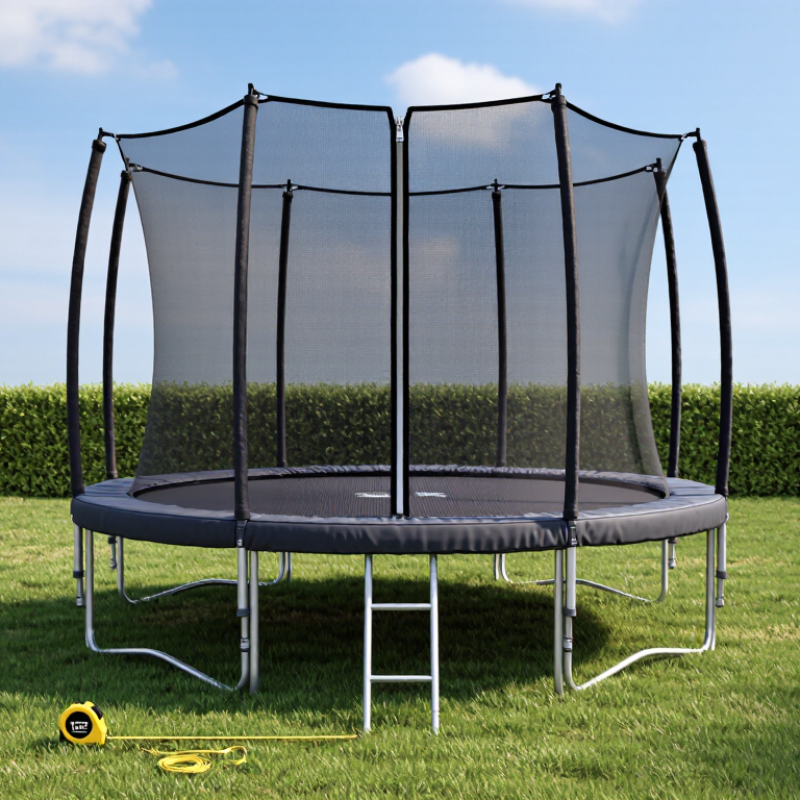
A round trampoline has a circular frame and jumping mat, usually joined by evenly spaced springs. Its shape can encourage a jumper to move toward the center, but it cannot prevent falls. Frame diameter, mat size, spring placement, and enclosure design all affect how the equipment performs.
Look closely at the edge: the spring cover should stay in place and cover the springs, while the enclosure should attach securely without obvious gaps. Small details matter.
ASTM F381 is a consumer safety specification for trampoline components, assembly, and use. It sets requirements and test methods intended to reduce common hazards; it is not a promise that every accident can be prevented. When comparing round trampolines, check the product documentation for a clear statement about ASTM F381 and the edition referenced. Then make sure the manual matches the model and explains assembly, user limits, inspections, and safe use.
A label alone is not enough. I would also check for bent frame sections, loose hardware, torn mat stitching, and worn padding after assembly. Easy to miss. Standards and product designs can change, so verify current documentation rather than relying on an old listing or a vague safety claim.
Choose Diameter and Capacity Using the Manufacturer’s Rated User Limits
When choosing a round trampoline, compare its diameter with the manufacturer’s rated user limits—not just the number of people shown in a product photo. The rating may specify a maximum weight or allow only one jumper at a time. Read the manual and product label carefully, since “capacity” can mean different things across models. A larger jumping surface does not automatically mean a higher weight limit.
Measure the yard before choosing a size. Leave clear space around the frame, and check for overhead branches, fences, or hard surfaces nearby. Then match the stated limit to the intended users’ combined weight, if multiple jumpers are explicitly permitted. Stay below the limit rather than treating it as a target. Children grow, and their weight changes; a model that fits this year may not fit next year.
Check whether the rating applies to one user or several, and follow the stricter instruction if packaging and manual wording differ. If the information is unclear, ask the seller or manufacturer before buying. That extra step can feel fussy. It is still better than guessing from diameter alone. Also inspect the frame and enclosure details, because a weight rating does not describe every aspect of safe use. A roomy trampoline can be the wrong choice when its rated limit does not suit the household.
How to Choose the Best Round Trampoline in 2026 — Choose Diameter and Capacity Using the Manufacturer’s Rated User Limits
| Nominal frame diameter | Approx. diameter | Approx. circular frame footprint | Rated user limit | Practical selection check |
| 8 ft | 2.44 m | Approx. 4.7 m² | Check the exact model’s label or manual; diameter alone does not determine the limit. | Compare the available installation area with the product’s stated overall dimensions. |
| 10 ft | 3.05 m | Approx. 7.3 m² | Check the exact model’s label or manual; diameter alone does not determine the limit. | Confirm the intended jumper’s weight is within the stated maximum user weight. |
| 12 ft | 3.66 m | Approx. 10.5 m² | Check the exact model’s label or manual; diameter alone does not determine the limit. | Allow for the full frame footprint and follow the model’s installation instructions. |
| 14 ft | 4.27 m | Approx. 14.2 m² | Check the exact model’s label or manual; diameter alone does not determine the limit. | Choose this size only if the site can accommodate the complete product as specified. |
| 15 ft | 4.57 m | Approx. 16.4 m² | Check the exact model’s label or manual; diameter alone does not determine the limit. | Verify the stated user limit and installation requirements before purchase. |
| 16 ft | 4.88 m | Approx. 18.4 m² | Check the exact model’s label or manual; diameter alone does not determine the limit. | Do not use a larger diameter as a substitute for checking the rated user limit. |
How to use this table: Frame areas are approximate geometric estimates calculated from the nominal diameter; actual product dimensions and measuring conventions can vary. Trampoline diameter does not establish a universal weight capacity. Check the exact model’s manufacturer-rated maximum user weight and follow its instructions. Use the trampoline with one jumper at a time.
Compare Frames, Mats, Springs, and Enclosures Against ASTM F381
A round trampoline should be judged as a connected safety system, not by its diameter alone. Use ASTM F381 as a reference point, then confirm that the product documentation identifies the applicable standard and explains how compliance was assessed. A label is useful, but it does not replace careful assembly or regular checks.
Look closely at the frame and joints. Tubing should feel stable, with no sharp edges, loose fittings, or exposed openings. The mat should sit evenly and show secure attachment points. Springs need consistent coverage beneath the pad; gaps or worn stitching deserve attention. Small details matter.
The enclosure should attach securely to the frame and close without a large gap. Check that poles are padded and that the net is free of tears or sagging. ASTM F381 addresses consumer trampoline safety, but no standard makes every setup risk-free. Follow the manual, keep the trampoline on level ground, and inspect it after installation and through the season. I would pause if the instructions are vague. A tidy spec sheet can still leave questions, and that deserves a closer look.
Check Setup Space, Anchoring, Inspection, and Replacement-Part Availability
A round trampoline needs more room than its advertised diameter suggests. Measure the frame, then leave the clearance specified in its manual around every side. Check overhead branches, fences, sheds, and hard surfaces too. Measure twice. A level, well-drained area helps the frame sit evenly; uneven ground can make assembly awkward and affect stability. Do not assume a soft lawn makes every location suitable.
Anchoring depends on the frame design and the ground beneath it. Follow the maker’s instructions for compatible anchors, and check them after strong wind or heavy rain. Before each use, look for bent frame sections, loose joints, worn springs, torn mat fabric, damaged netting, and shifted padding. Small details matter. Stop use if a safety component is damaged, and consult the instructions about repair or replacement rather than guessing.
Before buying, check whether replacement parts are available for that exact model and frame size. Confirm measurements and attachment styles for nets, mats, springs, and pads; parts that look similar may not fit securely. Save the manual and model information. It is tempting to treat diameter as the whole footprint, but that is worth reconsidering. Recheck the space once the enclosure and ladder are included, since those are easy details to miss.
How to Choose the Best Round Trampoline in 2026
Check setup space, anchoring, inspection, and replacement-part availability.
Common planning guidance is to allow at least 3 feet of open space around the trampoline and 24 feet of unobstructed space above it. Check the product instructions and local guidance, which may call for more clearance. Before choosing a model, confirm that it can be securely anchored for your site, inspect it before each use for damage or loose parts, and verify that compatible replacement parts are available.


