How to Choose the Best Flag Banner Pole in 2026?
Choosing a Flag Banner Pole in 2026 is not just a question of height or price. The right pole must suit the banner, mounting location, and expected weather. A feather flag beside a shop entrance needs different support from a tall roadside display. Look closely at the base, connectors, material, and replacement-part availability. Small details matter. A loose joint can turn a neat display into a leaning one.
The Outdoor Advertising Association of America reported that U.S. out-of-home advertising revenue reached $9.1 billion in 2024. That figure covers a broad advertising category, not flag poles specifically, but it shows how much attention businesses compete for outdoors. Product-design expert Dieter Rams offered a useful principle: “Good design is as little design as possible.” Applied here, that means choosing a pole that is simple to set up, stable in its intended conditions, and easy to maintain—not one crowded with features you may never use.
This guide compares common pole materials, heights, bases, and portability. It also explains what to check before ordering, including banner dimensions and the surface where the pole will stand. A practical caution: published wind claims can be hard to compare when test conditions differ. Check the manufacturer’s specifications, and don’t assume one setup suits every site. There is no perfect pole for every display. The best choice is the one that fits your banner and location, with a little room for real-world imperfections.
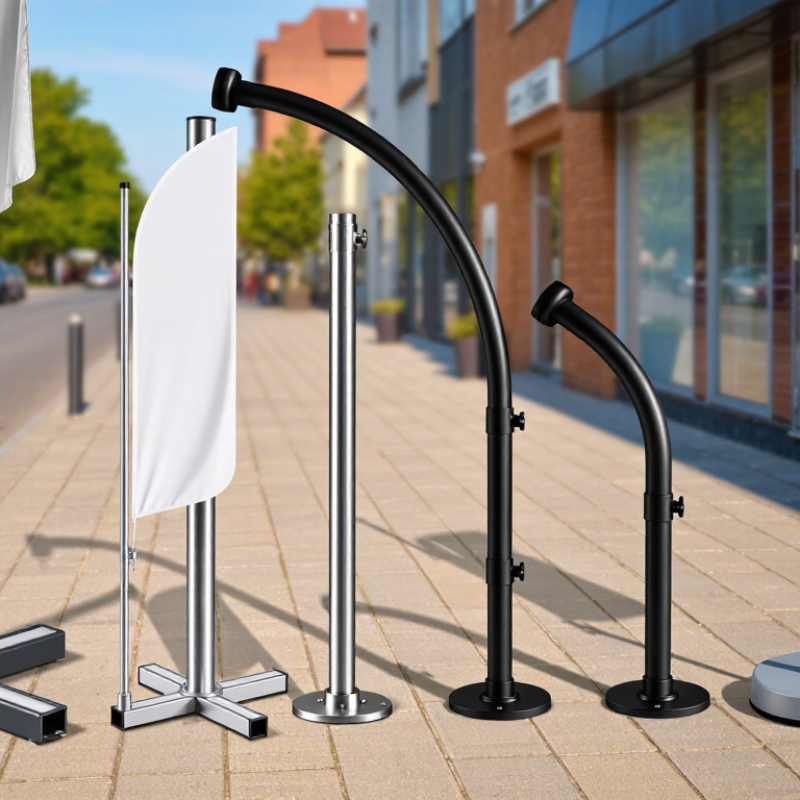
Define Banner Size and Deployed Height Before Selecting a Pole
Set the banner dimensions and deployed height before comparing poles. Measure the fabric itself, then note how far it will sit above the ground. A wider banner catches more wind; a taller setup also gives wind greater leverage on the pole and base. Measure both. Include the attachment points and any clearance needed near walkways or vehicles. A pole’s advertised length may include sections that remain inside the base, so verify the usable height.
Match the planned setup to local wind exposure, not just the banner’s weight. ASCE/SEI 7-22 evaluates wind design using factors such as basic wind speed, exposure, and structure height. NOAA’s 2023 U.S. Billion-Dollar Weather and Climate Disasters report recorded 28 events, with estimated losses of $92.9 billion. Those figures are not banner-specific, but they underline why weather exposure deserves attention. Check the site’s typical gusts and the pole maker’s published limits. Then confirm the base suits the surface, whether pavement, soil, or a weighted stand. Small details matter. I would still recheck the deployed height on site; measurements can shift once the base and fittings are assembled.
Match Wind Ratings to ASCE 7 Site-Specific 3-Second-Gust Speeds
How to Choose the Best Flag Banner Pole in 2026?
Match a pole’s wind rating to the site’s ASCE 7 design gust, not a regional average. ASCE 7-22 defines basic wind speeds as 3-second gusts at 33 feet in Exposure C. The standard’s wind maps also account for risk category, so check the value for the actual site. A 50 mph rating is not directly comparable if the test height, exposure, or gust basis differs. Check the fine print.
For a coastal parking lot, an open-field rating may not reflect nearby buildings, terrain, or the pole’s installed height. Compare the pole’s documented capacity with the site-specific value, and ask how the rating was established. NOAA’s Storm Events Database can provide context about recorded local storms, but observed gusts are not substitutes for ASCE design speeds. I would not use the nearest town’s storm record as the design number; that shortcut is tempting, but it can mislead.
Tips: Look up the site in the ASCE 7 Hazard Tool or applicable wind-speed map. Confirm risk category and exposure with a qualified design professional. Then request written test or engineering documentation for the pole. If the supplier cannot explain its rating basis, pause. A little uncertainty remains: nearby obstructions and installation details can change how a banner behaves in gusts.
How to Choose the Best Flag Banner Pole in 2026? - Match Wind Ratings to ASCE 7 Site-Specific 3-Second-Gust Speeds | Illustrative 3-Second-Gust Speed | Basic Reference Velocity Pressure | Relative Pressure vs. 90 mph | Pole and Banner Selection Checks |
| 90 mph | 20.7 psf | 1.00× | Use only when the project’s applicable ASCE 7 map speed and site conditions support it. Confirm the pole, base, anchors, and banner are evaluated as one assembly. |
| 100 mph | 25.6 psf | 1.23× | Check the design documentation for the same banner dimensions and mounting configuration. Do not treat a general product wind claim as an engineered site rating. |
| 110 mph | 31.0 psf | 1.49× | Verify pole bending strength, base and anchor capacity, and the supporting substrate. Confirm whether the stated wind limit means operation or survival while lowered. |
| 120 mph | 36.9 psf | 1.78× | Obtain project-specific structural review where required. Include the actual banner area, attachment details, pole height, and exposure conditions in the evaluation. |
| 130 mph | 43.3 psf | 2.09× | Require documented design or test information applicable to the complete installation. A stronger pole alone does not establish the capacity of the base, anchors, or foundation. |
| 140 mph | 50.2 psf | 2.42× | Use an engineered assessment for the specific site and assembly. Check local code requirements and whether the design accounts for topography and wind exposure. |
| 150 mph | 57.6 psf | 2.78× | Do not select from a generic speed chart alone. Have a qualified design professional assess the pole, banner, connections, foundation, and applicable site-specific wind parameters. |
How to use this table: The speeds are illustrative comparison points, not ASCE 7 wind zones or recommendations for a particular location. Obtain the applicable 3-second-gust speed from the adopted ASCE 7 edition and the project’s risk category and site location.
Pressure note: Reference pressures are rounded values calculated as q = 0.00256V², with V in mph and q in psf. They are simplified baseline values, not final design pressures. ASCE 7 design calculations may require exposure, directionality, topographic, elevation, and other applicable factors.
Before purchase: Match any documented wind capacity to the actual banner size, pole height, base, anchors, and installation. Confirm whether a stated wind speed is an operating limit or a survival limit, and follow the manufacturer’s instructions for lowering or removing the banner in high winds.
Check Base Load Capacity Against Banner Size and Ground Conditions
A flag’s base should be selected for the banner’s exposed area, pole height, and local ground—not just the pole’s advertised maximum height. ASCE/SEI 7-22 calculates wind effects using the square of wind speed, with additional factors for exposure and other conditions. Under the same assumptions, a 90 mph wind produces about 2.25 times the pressure of a 60 mph wind. That difference matters. A wide banner can catch gusts like a small sail, especially when mounted high.
Check the base’s rated load and the conditions behind that rating. A water-filled base on level pavement may behave very differently from one on soft soil or uneven gravel. For turf or loose ground, consider a compatible stake or anchoring system; for hard surfaces, verify that the base cannot slide or tip. Keep the banner area within the pole and base maker’s limits, and allow for gusts, not only average wind. NOAA local wind records can help identify typical conditions, but they do not replace a site-specific design check. I’d be cautious about treating any single weight figure as universal. The ground may be the weak link.
How to Choose the Best Flag Banner Pole in 2026?
Compare the estimated wind load with the banner’s area, pole height, and installation surface. The chart shows estimated wind force per square metre for a flat banner at different wind speeds.
How to use it: Multiply the chart value by the banner area to estimate total wind force. The estimate uses standard air density (1.225 kg/m³) and a drag coefficient of 1.2 for a flat panel. Actual loads vary with gusts, banner shape and porosity, pole height, and exposure. Check the pole and base’s rated capacity, and choose anchoring appropriate to the ground: soft soil may need a ground stake, while hard surfaces typically require a compatible weighted or fixed base. Follow the manufacturer’s wind limits.
Verify Hardware Compatibility, Replacement Parts, and Warranty Coverage
How to Choose the Best Flag Banner Pole in 2026?
A reliable pole starts with a precise fit. Check the flag’s sleeve or attachment style, then compare it with the pole’s diameter, connector, and mounting base. A close-looking match may still leave the flag loose or prevent the hardware from locking securely. Measure the existing parts before ordering, and keep a photo of each connection for reference. Small details matter.
Ask whether replacement sections, clips, and end caps are available separately. A small broken connector should not force you to replace an otherwise sound pole. Confirm the exact pole series and part dimensions in writing; “universal fit” can be less universal than it sounds. Review the warranty for its duration, covered components, and exclusions, including damage from improper assembly or strong wind. Save the receipt and warranty terms. I would not assume that a warranty covers every part, even when the pole itself is covered.
Tips: Check each joint before raising the banner. Look for cracks, bent sections, and loose fasteners. Keep one spare connector if replacements are difficult to find. Some measurements are easy to overlook, so recheck them before purchase.


