Top Walking Umbrella Types for Global Buyers
For global buyers, a Walking Umbrella is more than a canopy on a stick. It must suit the people who carry it, the weather they face, and the way retailers present it. A classic stick umbrella offers a full-length shaft and a familiar curved handle. Compact folding models save space, while vented canopies may help release gusts. Each style involves trade-offs. Details matter.
This guide compares popular walking umbrella types through practical buying criteria: frame construction, canopy fabric, opening mechanism, handle comfort, and packed dimensions. A product sample can reveal details a specification sheet may miss, such as a slippery grip, stiff runner, or canopy that catches on a doorway. Buyers should also check materials, stitching, finish, and packaging consistency across samples. Small flaws add up. No model wins everywhere.
Climate, price point, intended user, and sales channel all affect the right choice. A sturdy design may appeal to commuters, while a lighter option can suit shoppers who value easy carrying. These are useful starting points, not guarantees of performance. Ask suppliers for clear specifications and assess products against realistic use conditions before placing a larger order. This overview helps buyers compare common types, identify useful questions, and choose with fewer surprises.
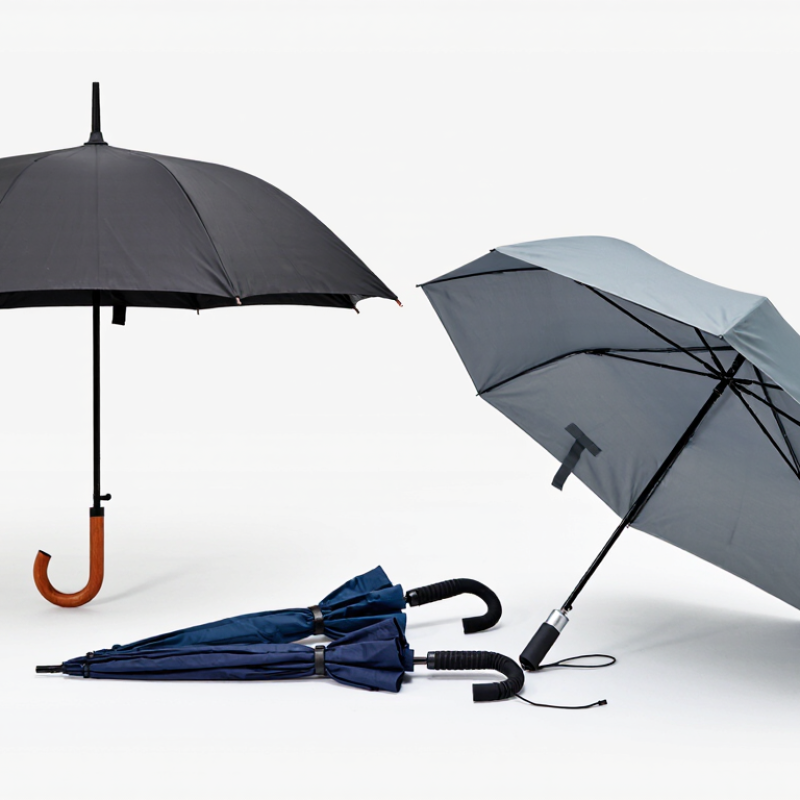
Walking Umbrellas Defined: Main Components and Typical 40–60-Inch Canopies
A walking umbrella has a full-length shaft, a handle, a sliding runner, stretchers, ribs, and a canopy. The runner moves up the shaft and spreads the ribs when the umbrella opens. A small tip caps the top, while a ferrule covers the lower end. Simple parts, but each affects how the umbrella feels in daily use.
Canopies commonly range from about 40 to 60 inches across. A 40-inch canopy suits one person and is easier to carry through crowded streets. Around 50 inches offers more shoulder coverage. A 60-inch canopy can shelter two people, though it may feel bulky in wind or on a busy sidewalk. These figures are not always measured the same way. Some suppliers report the canopy’s arc; others give its open width. Ask which measurement is used before comparing samples. A number alone can mislead.
For buyers, check the frame as well as the fabric. Ribs support the canopy, and stretchers connect them to the runner. The shaft may be wood, metal, or another material; its stiffness and weight affect handling. A curved handle is easy to hang over an arm, while a straight handle packs more neatly. Test the opening action with dry hands and inspect the stitching near the rib tips. Small details matter. Still, one sample cannot predict every production batch, so verify dimensions and construction against the approved specification.
Walking Umbrella Types: Classic, Golf, Windproof, and Compact-Handle Models
Classic walking umbrellas suit daily commuting and frequent opening in crowded streets. A straight shaft offers steady leverage, while a curved handle hangs conveniently from a chair or coat hook. Golf umbrellas use wider canopies to cover shoulders and bags, but their size can feel awkward on buses or narrow sidewalks. Choose them for exposed walks, not every trip.
Windproof models often use vented canopies and flexible ribs to reduce strain during gusts. “Windproof” is not indestructible; inspect rib joints and test the grip when wet. Compact-handle models take less hand space and may suit shoppers carrying several bags. Smaller grips can feel less secure, though, so comfort matters more than a tidy product label. One trade-off remains. The WMO’s State of the Global Climate 2024 reports that global mean near-surface temperature reached 1.55 ± 0.13°C above the 1850–1900 average. That figure is climate context, not a local rainfall forecast. Global buyers should compare local wind and rainfall records with canopy size, frame weight, and how the umbrella feels in hand.
Canopy Performance: Water Repellency, Drying Time, and UPF 50+ Ratings
For global buyers, canopy performance is more than a finish that makes rain bead up. Water repellency depends on the fabric treatment, weave, and seam construction. A tight weave can help shed light rain, while poorly sealed seams may still let moisture through. Look for test results, not just a “waterproof” label. Beads are only a clue.
Drying time matters after a wet commute. A lightweight canopy often dries faster when opened in moving air, but humidity and fabric coatings change the result. Check whether the supplier tested drying under stated conditions. A damp umbrella left closed in a bag can stay wet for hours. Small detail, real inconvenience. I would not trust a single drying-time figure without its test method.
For sun protection, a UPF 50+ canopy transmits no more than about one-fiftieth of UV radiation under test conditions. That rating does not cover exposed skin around the canopy, and sun angle can leave gaps. Buyers should confirm that the rating applies to the finished canopy fabric, not merely a sample. Wear, stretching, and repeated use may affect performance, so ask how durability was assessed. Ratings help, but they are not a substitute for sensible sun protection.
Global Sourcing Criteria: Product Testing, MOQ, Packaging, and Lead Times
For walking umbrellas, sourcing decisions should begin with measurable tests, not showroom appearance. Request pre-production samples and test opening cycles, shaft stability, rib strength, canopy water shedding, and handle grip. Record pass criteria and test conditions in the purchase specification. A sample that passes once may still disappoint. Not enough.
Set minimum order quantities against real packing constraints. Carton size, inner protection, and handle orientation affect container use and damage risk. UNCTAD’s Review of Maritime Transport 2023 reports that over 80% of world merchandise trade by volume moves by sea. That makes carton dimensions and dispatch windows commercially important. Ask suppliers to quote MOQ tiers by color and packaging configuration, not only by total units.
Agree on lead times in separate stages: sample approval, material procurement, production, inspection, and shipment booking. The World Bank’s 2023 Logistics Performance Index assessed 139 countries, reflecting how logistics conditions vary between markets. Build a buffer for port congestion and customs handling, then confirm progress with dated production updates. The buffer can feel wasteful, but a fixed delivery promise without one is often less useful.
Representative Canopy Diameters by Walking Umbrella Type
Approximate product-specification examples, not market averages: canopy dimensions vary by design and measurement method. When sourcing, confirm product test requirements, MOQ, packed dimensions, and production lead time with each supplier.


