
VOLGA METAL INDUSTRIES
GST : 07AAAFI9511Q1ZZ

Call us
Call us

A Wood Cutting Board Set is more than a thick board beside the sink. It is a practical group of boards, often offered in different sizes, for vegetables, bread, meat, and daily preparation. The large board gives onions room to scatter safely. The smaller one handles a lemon or quick snack. Some sets also include a holder, juice groove, or storage tray.
Market data shows why this category keeps attracting attention. Grand View Research valued the global kitchen utensils market at approximately US$30 billion in 2023. Its report also forecasts continued growth through 2030. Mordor Intelligence reports similar expansion across household kitchenware, driven by home cooking, organized storage, and online purchasing. These figures cover more than cutting boards. Still, they reveal a broader consumer shift toward useful, durable kitchen tools.
Chad Ward, author of An Edge in the Kitchen, describes a cutting board as “the most important tool in the kitchen.” That idea is easy to understand. Every knife cut depends on a stable, forgiving surface. Wood can feel quieter and warmer than glass or hard plastic. It may also help protect a sharp edge when maintained correctly. Yet wood is not maintenance-free. It needs prompt drying, regular washing, and occasional food-safe oil. A careless routine can shorten its life.
Buying a set can improve workflow, but bigger is not always better. A beautiful five-piece set may occupy valuable counter space. The right Wood Cutting Board Set should match cooking habits, storage limits, board thickness, grain construction, and cleaning expectations. That choice deserves a closer look.
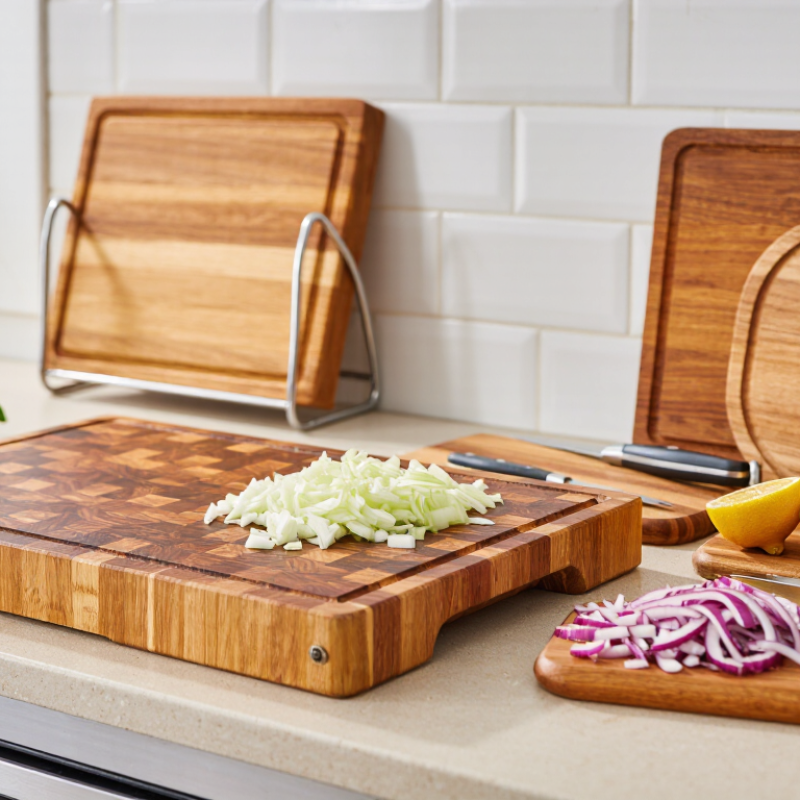
A wood cutting board set is a group of boards designed for different kitchen tasks. A typical set may include a large board for chopping, a smaller board for fruit, and a separate board for raw meat. Some sets also include a storage stand or shallow juice groove. The boards are usually made from hardwood, such as maple, walnut, or beech. End-grain construction can reduce visible knife marks, although it often costs more and needs careful maintenance. In practical use, size matters. A board that is too small lets diced onions spill across the counter.
The FDA Food Code 2022 permits hard maple or similarly hard, close-grained wood for cutting boards. It also requires food-contact surfaces to remain smooth, durable, and cleanable. USDA Food Safety and Inspection Service guidance recommends separate boards for raw meat, poultry, seafood, and ready-to-eat foods. That separation is important because the CDC estimates 48 million foodborne illnesses occur annually in the United States. A wood set can support safer routines, but it cannot replace washing hands or cleaning surfaces. Wash each board with hot, soapy water after use, then dry it upright. Never leave it soaking. That weakens the wood.
Oil it occasionally.
The imperfect part is maintenance. Wood can warp, stain, or develop deep grooves when neglected. A set is useful only when each board has a clear purpose, and when damaged boards are replaced rather than defended.
| Data Dimension | Typical Information | Practical Benefit | Recommended Use |
|---|---|---|---|
| Definition | A wood cutting board set is a group of two or more wooden boards in different sizes, shapes, or thicknesses. | Provides separate surfaces for different food-preparation tasks. | Useful for everyday meal preparation and organized kitchen work. |
| Common Set Quantity | Most household sets contain 2 to 3 boards. | Allows users to assign boards to produce, cooked foods, bread, or raw ingredients. | Choose a larger set when several preparation tasks are performed at the same time. |
| Small Board Size | Approximately 25 × 20 cm to 30 × 23 cm (10 × 8 in to 12 × 9 in). | Lightweight and easy to move or store. | Suitable for fruit, small snacks, herbs, and quick preparation. |
| Medium Board Size | Approximately 35 × 25 cm to 40 × 30 cm (14 × 10 in to 16 × 12 in). | Offers a practical balance between workspace and portability. | Suitable for vegetables, meat portions, and routine cooking. |
| Large Board Size | Approximately 45 × 30 cm to 50 × 35 cm (18 × 12 in to 20 × 14 in). | Provides more room for large ingredients and meal preparation. | Suitable for carving, batch preparation, large vegetables, and bread. |
| Typical Thickness | Most wooden cutting boards are about 1.5 to 4 cm (0.6 to 1.6 in) thick. | Thicker boards are generally more stable and less likely to warp when properly maintained. | Choose thinner boards for easy handling and thicker boards for heavy chopping. |
| Common Wood Types | Frequently used hardwoods include maple, beech, walnut, acacia, and teak. | Hardwoods can provide a durable cutting surface when responsibly manufactured and maintained. | Select according to hardness, appearance, weight, and care requirements. |
| End-Grain Construction | Wood fibers are oriented vertically, creating a checkerboard-like surface. | Often provides good knife contact and can help reduce visible knife marks. | Best for users seeking a premium, stable board and who accept higher weight and cost. |
| Edge-Grain Construction | Wood fibers run horizontally along the board surface. | Offers a durable, attractive, and commonly available cutting surface. | Suitable for general-purpose home cooking. |
| Knife Friendliness | Wood is generally gentler on knife edges than very hard surfaces such as glass or stone. | May help knives retain a usable edge during regular cutting. | Suitable for chopping, slicing, dicing, and carving with properly maintained knives. |
| Surface Stability | Weight, thickness, and non-slip feet influence how firmly a board stays in place. | A stable board improves control and reduces movement while cutting. | Choose a heavier board or use a damp kitchen towel underneath on smooth counters. |
| Food Separation | Multiple boards can be designated for different food categories. | Helps reduce cross-contact between raw ingredients and ready-to-eat foods when boards are cleaned correctly. | Use separate boards for raw meat, seafood, produce, and cooked foods. |
| Cleaning Method | Wash by hand with warm water and mild dish soap, then dry immediately. | Helps limit moisture absorption, odor retention, and warping. | Clean after every use, especially after handling raw meat, poultry, or seafood. |
| Dishwasher Compatibility | Wooden cutting boards are generally not recommended for dishwasher cleaning. | High heat and prolonged moisture may cause cracking, splitting, or warping. | Hand-wash and keep the board away from prolonged soaking. |
| Conditioning | Food-grade mineral oil or a suitable board conditioner can be applied periodically. | Helps reduce dryness and supports the board’s resistance to moisture changes. | Condition when the surface looks dry or feels rough; follow the care instructions supplied with the board. |
| Storage | Boards should be stored upright or in a well-ventilated position after they are fully dry. | Promotes even airflow and helps reduce trapped moisture. | Use a rack, divider, or open shelf rather than storing boards flat while damp. |
| Replacement Signs | Deep grooves, cracks, splitting, persistent odors, or severe warping indicate that replacement may be appropriate. | Maintains a smoother, more hygienic, and safer preparation surface. | Inspect boards regularly and replace those that cannot be cleaned effectively. |
| Main Buying Advantage | A set provides multiple sizes and dedicated surfaces in one coordinated purchase. | Improves flexibility, workflow, and kitchen organization. | Recommended for households that prepare varied foods or cook several dishes regularly. |
Care practices and dimensions may vary by wood species, construction method, and manufacturer instructions.


